
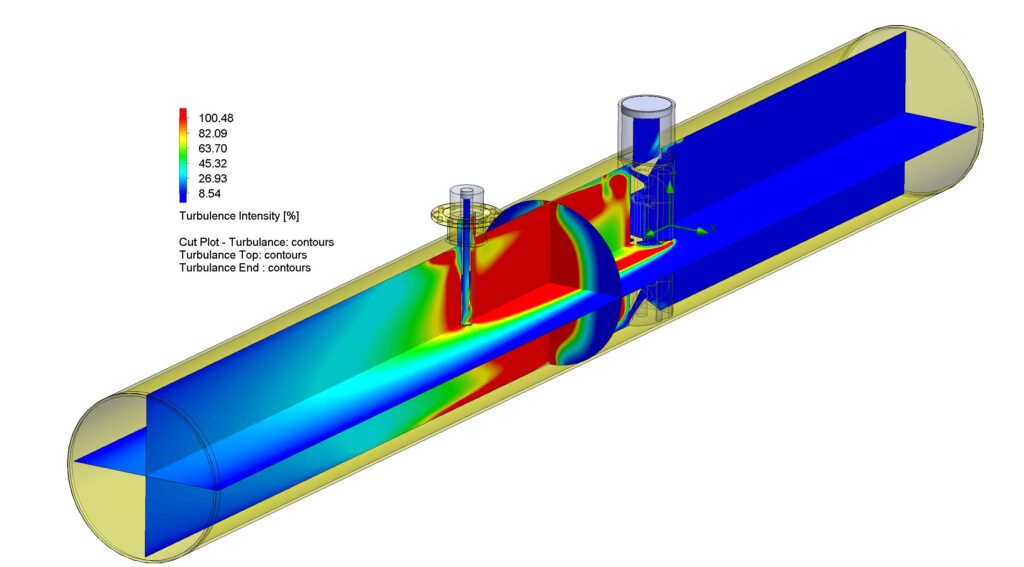
Fluimix designs automatic sampling systems for liquid hydrocarbons used in custody and fiscal transfer environments, where representative sampling is essential. In these applications, the quality of the sampling result depends heavily on how well the product is mixed at the sampling location, particularly when operating conditions vary significantly. Barair was engaged to provide an independent engineering assessment, supported by Computational Fluid Dynamics, to examine inline mixing behaviour and help Fluimix make robust design decisions.
The engineering challenge centred on maintaining homogeneity across a demanding operating envelope. In real pipelines, representative sampling can be undermined by viscosity changes, low-flow conditions, stratification, interface effects and pressure-loss constraints. These issues mean that a mixing concept cannot simply work under ideal conditions; it must remain credible across the range of operating scenarios likely to be seen in service. For Fluimix, the objective was to understand where the weak points were likely to occur and what design changes would deliver the greatest improvement.
Barair’s scope was to interrogate likely mixing mechanisms, identify geometry-driven vulnerabilities such as recirculation zones or low-shear regions, review pressure-loss sensitivity, and define the operating regimes most likely to represent worst-case conditions. The work also required a clear record of assumptions, boundary conditions and limitations so that the findings could be used in a design review or sign-off context.
A structured CFD workflow was used to support the assessment. The operating envelope was defined first, including the relevant flow range and fluid-property bounds. The geometry was then reviewed and prepared, with attention paid to the features most likely to influence mixing performance. A mesh strategy was selected to resolve high-gradient regions and near-wall behaviour, and the solver approach was chosen to suit the expected Reynolds number range and flow regime. Mixing indicators were agreed up front so that results would remain decision-focused rather than purely academic, and pressure-drop sensitivity was assessed alongside mixing performance to ensure that any proposed improvement remained practical within pipeline constraints.
The outputs from the work included a CFD findings pack suitable for internal and client engineering review, together with design recommendations prioritised according to likely impact and practical complexity. The study provided a documented basis for judging where design changes would improve robustness, where risks remained greatest, and what prototype or test actions should follow. In that way, the work gave Fluimix a clearer engineering position on inline mixing performance and a more defensible basis for future development decisions.
