FEA Verification Services - Finite Element Analysis
Finite Element Analysis (FEA) is a powerful verification method for checking whether a component, structure, frame, bracket, weldment, or machine assembly will perform safely under real loading. At Barair Systems Limited, FEA is used as part of a wider engineering verification process, not as a “black box”. We combine professional judgement, hand checks, sensitivity studies, and clear reporting so the results are defensible and useful for decision-making. Typical outcomes include confirming factors of safety, reducing weight/cost, solving fatigue or deflection issues, and providing evidence for design assurance, procurement, or customer sign-off.
Typical problems we solve
- A frame or support structure deflects too much and causes misalignment, vibration, or poor product quality
- A welded fabrication is cracking in service (fatigue) or showing unexpected distortion
- A bracket or mounting is overstressed due to shock loads, eccentric loads, or poor load paths
- A machine guard, platform, walkway, or lifting feature needs verification for safety and compliance
- A product is overweight/over-engineered and needs rationalisation without increasing risk
- A pressure-related assembly needs local stress checks around openings, bosses, welds, or flanges
- A component fails a prototype test and you need a redesign route that targets the true weak point
- You have hand calcs but need deeper insight into stress concentrations, stiffness, and load transfer
- You need third-party verification to support internal sign-off, insurers, or end-customer approval
FEA verification and validation
- Define the question clearly
What exactly are we verifying (strength, stiffness, buckling, fatigue, vibration, contact pressure, etc.) and what is “pass/fail”? - Gather inputs and agree assumptions
CAD, drawings, materials, loads, constraints, duty cycle, environment, acceptance criteria. - Idealise the model appropriately
We choose the right level of detail: 3D solids, shells, beams, or a hybrid approach. This matters as much as mesh density. - Apply realistic boundary conditions
Loads and supports are modelled to match how the item is truly connected and loaded in service (including bolt groups, weld lines, contact faces, and stiffness of mating parts where needed). - Mesh strategy and convergence checks
We start sensible, refine where gradients demand it, and avoid “false precision”. Where stress singularities exist, we report the correct engineering interpretation. - Solve with the right analysis type
Linear static where appropriate; nonlinear (contact, plasticity, large displacement) when required; buckling and/or fatigue assessments when relevant. - Validate with hand calculations / engineering sense checks
Simple calcs (bending, shear, bearing, bolt group, weld checks) are used to sanity-check results and identify modelling errors early. - Report results in an actionable way
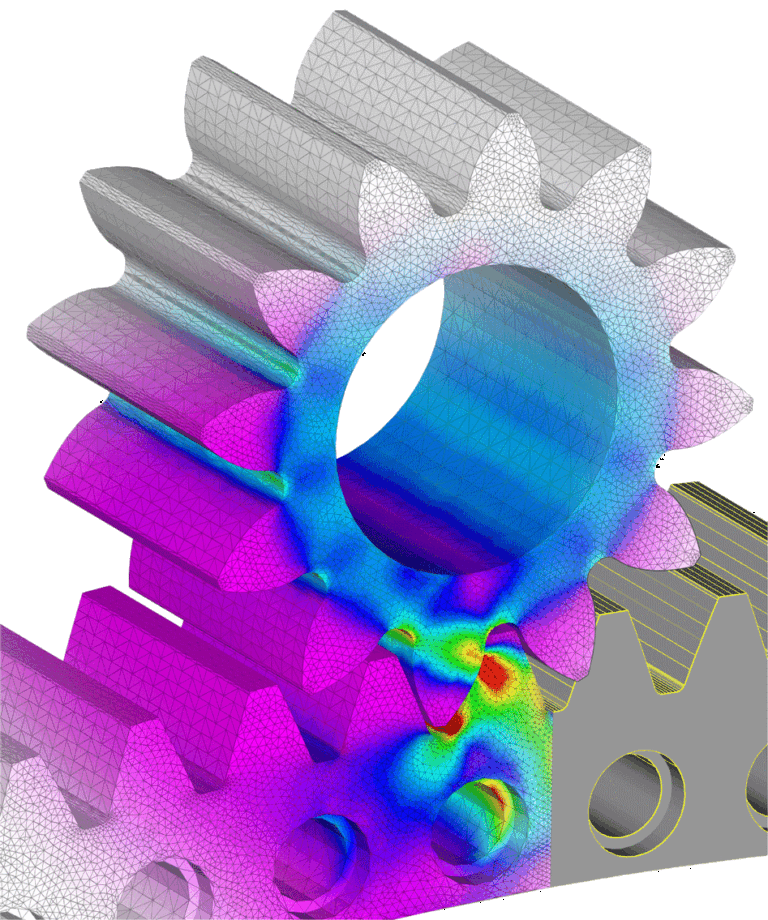
Not just contour plots; we provide clear findings, margins, critical areas, and practical changes to de-risk the design. - Support iteration
If the design needs changes, we can run controlled iterations to reach the target quickly and economically.
What you receive (deliverables)
Depending on the project, typical deliverables include:
A concise FEA verification report (PDF) with assumptions, load cases, boundary conditions, mesh strategy, and conclusions
Results summary: maximum stresses (and which stress measure is appropriate), deflections, reaction forces, factors of safety
Key images: deformed shape, stress/strain plots, critical sections, bolt/weld utilisation where relevant
A list of recommendations (e.g., stiffening, load-path improvements, weld detail changes, material changes, thickness changes)
A clear statement of limits: what is covered and what is not (scope boundaries)
Where required: supporting hand calculations and/or simplified checks to validate the analysis
Optional: design review notes suitable for customer/insurer sign-off
What we need from you (inputs)
To run an efficient, defensible analysis, we typically request:
CAD model (STEP/Parasolid) and/or drawings
Material specification(s) and any heat treatment/weld details if relevant
How the part is supported and connected in service (photos help)
Loads: forces, moments, pressures, weights, accelerations, duty cycles, shock factors
Any test results, failure photos, or measured deflections (if it’s a problem-solve job)
Operating environment: temperature, corrosion, vibration, wet/dry, chemical exposure
Acceptance criteria: allowable deflection, target factor of safety, fatigue life expectations, etc.
If available: any design codes/specifications the client requires us to work to
Standards & engineering framework (where applicable)
We work to the standards and frameworks appropriate to the equipment and industry. Depending on scope, this can include structural design approaches (e.g., Eurocode basis), fabrication and conformity requirements (e.g., EN1090 expectations for structural steelwork where relevant), and industry codes used for pipework and pressure-related equipment. If a project requires a particular customer standard or insurer-driven evidence pack, we align the report and deliverables to that requirement.
Related case studies
Wanlip: Air Main Support Structure FEA Verification (pressure integrity + engineering assessment) Suprafilt Ltd
Fluimix – Inline Mixing Development and CFD Study (design + manufacture + verification) Fluimix
JD Robinson steam pipework design compliance (verification to satisfy insurer expectations) JD Robinson’s Ltd
Request a design review
If you have a component, fabrication, or assembly that needs verification, or a problem that needs diagnosing properly; request a design review. We’ll tell you exactly what inputs we need and what you’ll receive back, before any analysis begins.