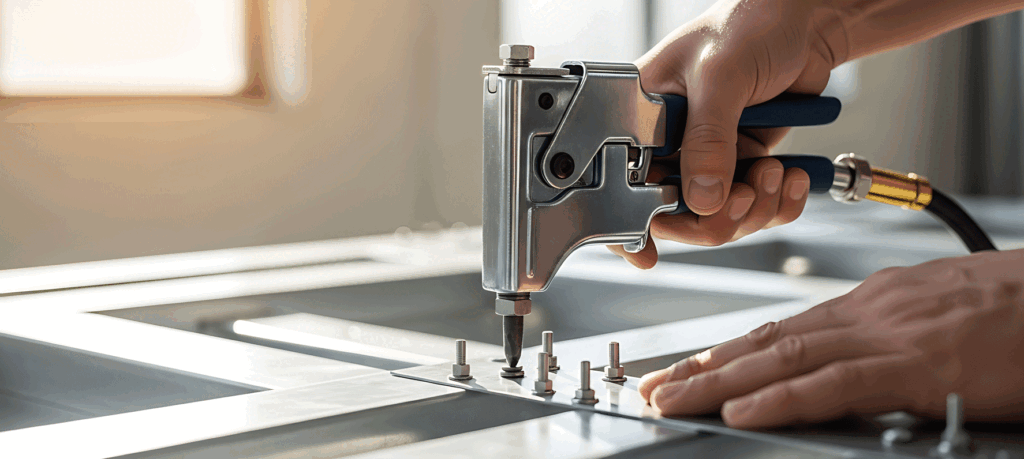
GESIPA develops joining technology and processing solutions for blind rivets, blind rivet nuts and associated tooling. For this project, Barair supported the development of a dedicated inspection and reject machine intended to prevent non-conforming rivet nut and stud assemblies from progressing further down the production line. The objective was to create a practical, buildable solution that combined reliable inspection with positive rejection and clear documentation for sign-off and commissioning.
In high-volume production environments, even a very small escape rate can create disproportionate problems. Incorrect components, incomplete assemblies, damage, missing features or orientation errors can all drive rework, line stoppages, containment activity and customer dissatisfaction. The requirement, therefore, was for a repeatable inspection method that could integrate into a production workflow and deliver a clear pass-or-reject outcome with minimal uncertainty.
The design had to account for several constraints. Defect modes needed to be detectable using a vision-led approach, supported by sensors where necessary. The reject method had to be positive and unambiguous, avoiding any possibility of mixed output. The target cycle time was fast, in the order of one to two seconds, so part presentation and decision-making had to be stable and repeatable. The system also needed to be maintainable in a real factory setting, with sensible access for cleaning, calibration, jam clearance and routine intervention, while meeting practical safety expectations around guarding and operation.
Barair’s approach was to treat the inspection function and reject mechanism as a single controlled process rather than separate design problems. The work began with defining the acceptance criteria clearly: what constituted a conforming assembly, what features had to be inspected, and which defects were unacceptable. From there, the mechanical concept focused on repeatable part presentation, because vision systems depend heavily on stable location, controlled orientation and consistent lighting. Reject handling was then integrated into the sequence as a designed part of the system, reducing dependence on operator judgement and lowering the risk of false passes.
The resulting concept comprised a controlled infeed and part-location arrangement, a vision inspection envelope with predictable lighting and contrast conditions, decision logic aligned to the acceptance criteria, and a reject mechanism designed to route non-conforming parts positively out of the good-product stream. The overall layout also considered operator access and maintainability so that the machine could be supported in service without excessive downtime or reliance on undocumented knowledge.
The delivered engineering position gave GESIPA a structured, buildable route toward improved quality control. It reduced the risk of defective assemblies proceeding downstream, supported repeatable inspection through controlled presentation and defined criteria, and provided a maintainable concept that could be built, commissioned and supported with confidence.
