Fluimix – Inline Mixing Development and CFD Study
Fluimix designs automatic sampling systems for liquid hydrocarbons used in custody/fiscal transfer environments, where representative sampling is critical. Their solutions combine sampling hardware with inline mixing CFD and in-line mixing concepts intended to improve homogeneity across challenging operating envelopes.
Project-at-a-glance
Client: Fluimix
Application: Hydrocarbon sampling (custody/fiscal transfer context)
Engineering focus: Inline mixing behaviour, homogeneity risk, pressure-loss sensitivity
Service delivered by Barair: Independent engineering assessment + Computational Fluid Dynamics (CFD) study to support design decisions
Outputs: Decision-grade findings, design recommendations, and a documented basis for review/sign-off
Background
Fluimix supplies a range of auto sampling system architectures, including in-line, fast loop, and power mix/jet configurations. These systems are positioned for applications where sampling uncertainty, batch interfaces, viscosity variation, and operating flow range can materially affect representativeness and custody transfer confidence.
The engineering challenge
Representative sampling depends on maintaining sufficient homogeneity at the sampling location, especially when real pipelines experience:
viscosity swings (refined products through heavier crudes),
low-flow operation where natural turbulence may be insufficient,
stratification/interface behaviour, and
pressure-loss constraints that limit “brute force” mixing options.
Fluimix’s product literature emphasises mixing approaches intended to support representative sampling across operating conditions, including systems stated to be aligned with international sampling standards (e.g., ISO/API/ASTM referenced on their solution pages).
Barair scope (what we actually assessed)
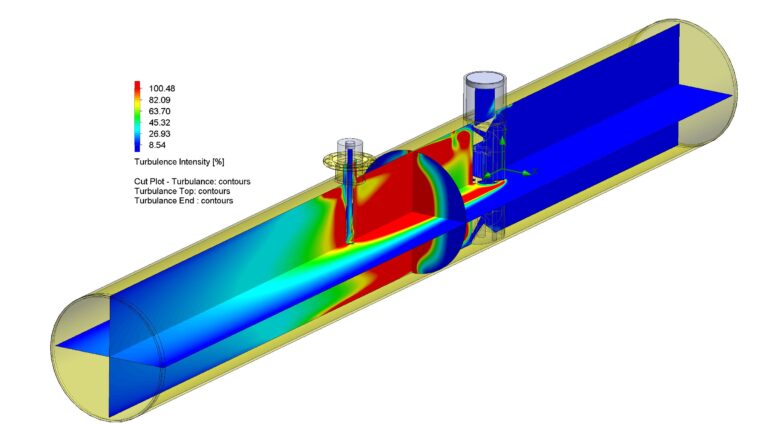
Barair’s role was to provide an independent engineering view using CFD to:
interrogate mixing mechanisms and likely weak points (geometry-driven recirculation, low-shear regions, short-circuiting),
review pressure-loss sensitivity of candidate concepts,
identify worst-case operating regimes (e.g., low-flow / high-viscosity scenarios),
propose geometry/process changes to improve robustness,
document assumptions, boundary conditions, and limitations clearly for design review.
CFD method
A typical workflow used for this type of assessment:
Define the operating envelope (flow range, viscosity bounds, representative fluid properties).
Build/clean the CFD geometry (mixer element / spool features / injection or recirculation paths as applicable).
Mesh strategy suitable for near-wall and high-gradient regions (documented element sizing and refinement areas).
Solver model selection appropriate to the expected Reynolds number range and flow regime.
Mixing indicators agreed up-front (e.g., dispersion uniformity, velocity distribution, residence time effects, qualitative risk flags).
Pressure-drop sensitivity check against practical pipeline constraints.
Design iteration loop: compare variants and report what actually moves the needle.
Outputs delivered
CFD findings pack suitable for internal/client engineering review
Geometry/design recommendations prioritised by impact vs. complexity
Clear assumptions and operating validity range
Actions list (what to prototype/test next, and why)

Adrian Lowes BEng(hons) CEng MIMechE ASME
Adrian Lowes is a Chartered Mechanical Engineer and the founder of Barair Systems Limited, with over two decades of experience delivering innovative engineering solutions.
A graduate of the University of Bradford, he has worked on projects from automated vision systems for the automotive industry to oil and gas research with Cranfield University. He has developed products for brands including Microsoft, ICI, Toyota, and Florette. His expertise spans machinery design, finite element analysis, CE marking, and industrial accident investigation.
A lifelong musician, Adrian has directed Skipton Brass and Brass Ten, and served on the Alumni Committee of the National Youth Brass Band of Great Britain. Based in West Yorkshire, he combines technical precision with creative problem-solving in every project.
Related Barair services
Call to Action
If you need evidence-led support for inline mixing, flow distribution, or process hardware changes under real constraints, request a design review and share what you have (drawings, photos, operating range).