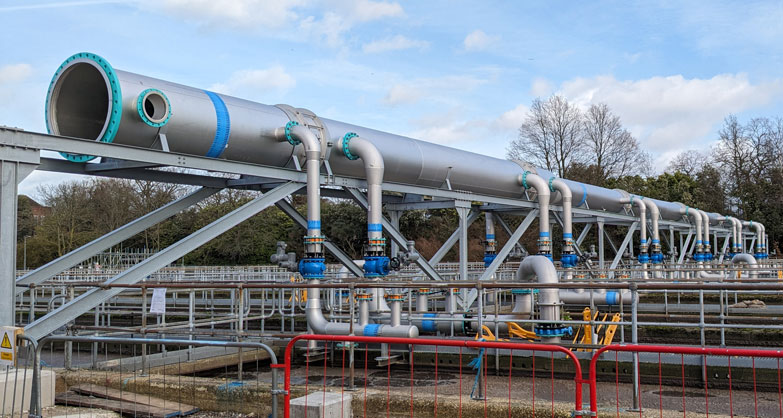
Suprafilt – Mogden WwTW: Retrofit Support Structures (Design + FEA)
Barair Systems Limited supported a wastewater-sector project at Mogden by providing mechanical engineering verification and practical design support to reduce delivery risk and improve reliability in service. Wastewater projects frequently involve constrained installations, aggressive environments, and equipment that must operate continuously with minimal intervention. Engineering decisions therefore need to be buildable, maintainable, and supported by clear evidence.
This work focused on establishing a credible design basis, verifying the critical mechanical aspects of the design, and producing a structured set of findings and actions that could be used for sign-off and implementation planning.
The challenge
In operational wastewater assets, the challenges are typically a combination of:
-
limited access and short shutdown windows
-
corrosion/washdown exposure and contamination driving wear
-
legacy interfaces and incomplete drawings at existing assets
-
the need for clear documentation and traceability to support approval
For Mogden, the goal was to ensure that the mechanical aspects of the proposed arrangement were robust, and that practical vulnerabilities (interfaces, maintainability and installation constraints) were identified early, before they created downtime, rework, or project delay.
Engineering scope
Barair’s scope typically includes (as applicable to the specific system):
Review of geometry, load paths, supports and interfaces
Verification checks for strength, stiffness and deflection where appropriate
Review of joints and connection detailing (bolts/welded details)
Identification of reliability risks (wear points, stress concentrations, corrosion traps)
Practical recommendations to improve maintainability and reduce risk
Decision-grade documentation suitable for client/internal approval
Where the geometry and load paths justified it, finite element analysis (FEA) was used to support local stress/deflection assessment; otherwise, targeted hand checks were used to confirm the design basis efficiently.
Method (how we approached the work)
Inputs and assumptions
Review of drawings/dimensional data, site context, and operating duty to define credible assumptions and load cases.Boundary conditions and interfaces
Support conditions and interface constraints were defined to reflect the real installation rather than idealised conditions.Verification checks
Critical features were assessed for utilisation, stiffness/deflection and stability risk; joints and interfaces were reviewed for robustness.Risk identification and action list
Practical issues were captured with clear recommendations, prioritised by risk and ease of implementation.Close-out and handover
Outputs were structured so they could be used by decision makers, suppliers and installers.
Deliverables
Engineering review summary with scope, assumptions and conclusions
Verification checks (strength/stiffness/deflection/stability as applicable)
Risk-based action list (critical / major / minor)
Interface and maintainability notes to reduce implementation risk
Optional FEA verification summary (where applied)
Evidence pack structure suitable for project approval and handover
Outcome
The project team received a clear engineering position and practical recommendations that reduced risk prior to implementation. By combining verification with maintainability and interface thinking, the outputs supported a more reliable outcome in service and improved the likelihood of a smooth installation within constrained shutdown windows.

Adrian Lowes BEng(hons) CEng MIMechE ASME
Adrian Lowes is a Chartered Mechanical Engineer and the founder of Barair Systems Limited, with over two decades of experience delivering innovative engineering solutions.
A graduate of the University of Bradford, he has worked on projects from automated vision systems for the automotive industry to oil and gas research with Cranfield University. He has developed products for brands including Microsoft, ICI, Toyota, and Florette. His expertise spans machinery design, finite element analysis, CE marking, and industrial accident investigation.
A lifelong musician, Adrian has directed Skipton Brass and Brass Ten, and served on the Alumni Committee of the National Youth Brass Band of Great Britain. Based in West Yorkshire, he combines technical precision with creative problem-solving in every project.
Related services
Water & Wastewater Engineering Support
Process & Plant Modifications
Design Assurance & Independent Design Checks
Finite Element Analysis (FEA) Verification
Failure Investigation & Root Cause Analysis
Key deliverables
Engineering review summary with clear assumptions and conclusions
Verification checks (strength/stiffness/deflection/stability as applicable)
Risk-based action list (critical / major / minor)
Interface and maintainability notes to reduce implementation risk
Optional FEA verification summary (where applied)
Evidence pack suitable for client/internal sign-off
Call to action
If you have a wastewater asset that needs verification, retrofit design, or reliability-focused improvement with evidence suitable for sign-off, request a design review. We’ll define the constraints and deliver buildable outputs with the right level of verification.