Machine Design Services for Bespoke Machinery
Bespoke machine design is about creating equipment that reliably performs a specific industrial function; safely, repeatedly, and profitably. This may involve automating a manual process, increasing throughput, improving quality, integrating inspection, reducing downtime, or making a line safer and easier to maintain.
At Barair Systems Limited, we design machines and tooling with a practical “build and run” mindset: robust mechanics, sensible tolerances, maintainable assemblies, and verification where it matters. Whether you need a concept developed from scratch or an existing machine improved, we provide an engineering-led route from requirements to detailed design and commissioning support.
Typical problems we solve
- Manual processes causing inconsistent quality, high labour cost, or ergonomic/safety risk
- Bottlenecks in production limiting throughput and delivery performance
- High scrap/rework because the process isn’t controlled or repeatable
- Existing machines are unreliable, difficult to maintain, or no longer supported by the OEM
- New product introduction requires new tooling, fixtures, or automation quickly
- You need an inspection / accept-reject stage to protect downstream production
- A machine must integrate with existing conveyors, guarding, sensors, or PLC control
- Space constraints and awkward access mean “off-the-shelf” solutions don’t fit
- You need documentation and design assurance for internal sign-off, customer acceptance, or insurer review
From Concept to Manufacture-Ready Machine Design
Define the requirements
We agree the function, throughput, cycle time, quality criteria, envelope/space, interfaces, utilities, and constraints.Concept development
We generate practical concepts with pros/cons and identify key risks early (accuracy, forces, wear, cleaning, safety, jamming).Design for reliability and maintainability
We consider access for adjustment and maintenance, guarding, lubrication, wear parts, and fault recovery (so the machine is usable, not just clever).Engineering calculations and verification
Where appropriate we verify frames, tooling loads, drives, fasteners, welds, lifting points, and critical deflections. FEA is used when it adds value.Detailed design and drawings
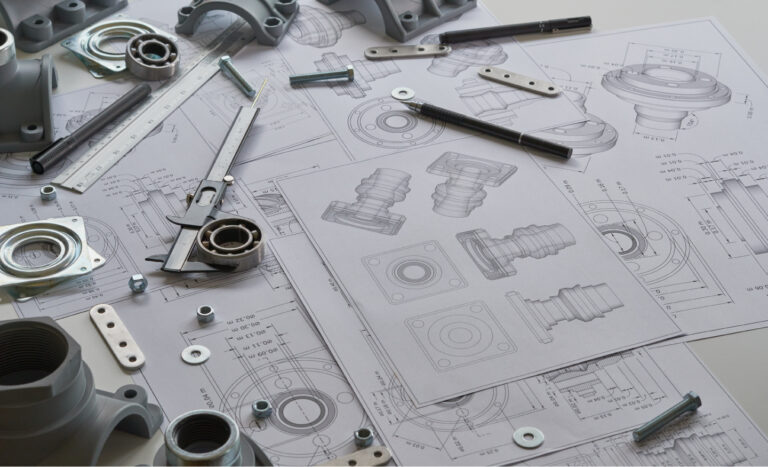
We produce manufacturing-ready drawings, BOMs, and assembly information to suit your fabrication/machining capability.Supplier liaison / build support
We can support procurement, answer supplier queries, and ensure the design intent is maintained through manufacture.Installation and commissioning support
We assist with installation planning, risk-based testing, trial runs, and iterative improvement to reach stable production.Documentation handover
You receive a coherent design pack that supports maintenance, modifications, and future upgrades.
Deliverables (what you receive)
Depending on scope, typical outputs include:
Concept layouts and design notes
3D CAD (where required) and detailed manufacturing drawings
Bill of materials (BOM) and specification notes
Engineering verification checks (hand calcs and/or FEA summary where appropriate)
Installation and commissioning support notes
A structured technical file / evidence pack approach (where required)
Practical recommendations for guarding, access, maintenance and safe operation
What we need from you (inputs)
To progress quickly, we typically ask for:
A short description of the process and what “good” looks like (quality criteria)
Throughput / cycle time targets and duty cycle
Product/part details (drawings, samples, variability range)
Existing line info: interfaces, available space, constraints, utilities (air, power, hydraulics)
Photos/video of the current process (very useful)
Any known failure modes, jams, or quality escapes
Your preferred build route (in-house, local fabricator, specialist OEM) and timescale
Design considerations we routinely address
Forces, stiffness and alignment (to protect quality and reduce rework)
Tolerance strategy (datum structure, adjustment, shimming, repeatability)
Wear and life (bearings, guides, seals, surface finishes, lubrication)
Safety and guarding (risk-based thinking, access, interlocks as needed)
Serviceability (how quickly can it be cleaned, adjusted, repaired, and returned to production?)
Inspection and fault handling (reject mechanisms, fail-safe behaviour, operator feedback)
Related case studies
Typical deliverables
Requirements capture and concept options (with pros/cons)
3D CAD and manufacturing drawings (fabrication/machining-ready)
Bill of Materials (BOM) and specification notes
Verification checks (strength/stiffness, fasteners, welds, lifting points where applicable)
Build support: supplier liaison and design clarification
Installation, commissioning and improvement support to reach stable production
Request a design review
If you have a process that needs improving; higher throughput, better quality, less downtime, or a safer and more repeatable operation. Request a design review. We’ll clarify the requirements, define the quickest engineering route, and produce a practical design pack that can be built and supported.