
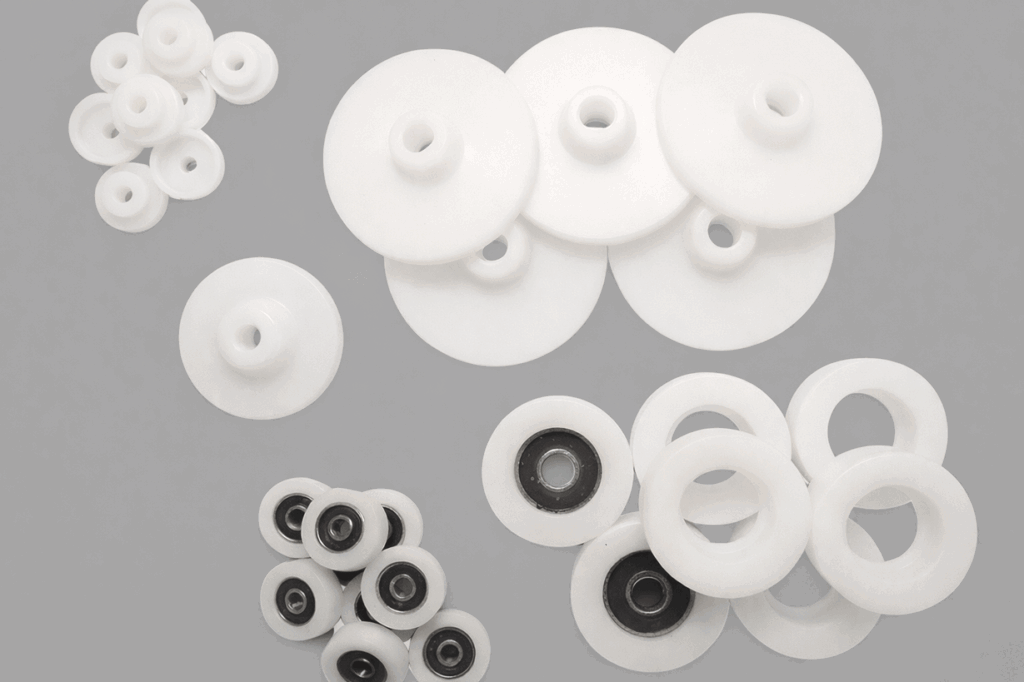
Barair supplies precision plastic components and assemblies for industrial customers who need repeatable batch manufacture without losing the flexibility to refine designs as projects evolve. The work typically spans prototype parts, small-batch supply and repeatable production, combining practical design-for-manufacture support with managed machining, inspection and assembly where required.
This type of work is often needed where customers want the benefits of engineering plastics but do not yet have a volume that justifies mould tooling, or where the design is still developing and must remain adaptable. In these cases, the challenge is not just to machine the part accurately once, but to create a supply route that makes re-ordering, revision control and acceptance straightforward over time.
Barair supports CNC-machined plastic parts, assembly-ready components and assembled sub-systems, including parts where bearings, bushes or simple mechanical features are integrated before delivery. Applications commonly include conveyor and material-handling components, industrial machine parts, prototype development items and low-to-medium volume batch products where control of geometry, fit and finish matters.
Acetal, or POM, is a core material in this work because of its dimensional stability, machinability and stiffness, but Barair also supports other engineering plastics where the duty requires it. Material selection is considered in relation to load, wear, lubrication, temperature, chemical exposure and creep risk so that the chosen polymer matches the real service conditions rather than simply the nominal geometry.
A key part of the service is making sure the supply route is controlled and repeatable. Drawings and specifications are kept clear, critical features are identified explicitly, and the inspection approach is defined so that repeat batches remain consistent. Where helpful, first-off or sample verification can be used to confirm acceptance before repeat production proceeds. When assemblies are required, Barair can also coordinate simple integration steps such as pressing in bearings or bushes and carrying out fit checks against defined interfaces.
The working method typically begins with defining the requirement in practical terms: function, environment, quantities, interfaces and what acceptable performance looks like. Material and manufacturing route are then confirmed, followed by design-for-manufacture input where needed to improve cost, tolerance control or repeatability. Prototype or first-batch supply then provides a validation stage before repeat orders are established with controlled revisions, consistent inspection and realistic lead-time planning.
The result is a responsive, engineering-led supply route for precision plastic components and assemblies, giving customers the ability to develop, order and re-order with confidence while retaining a clear technical basis for sign-off and future production.
