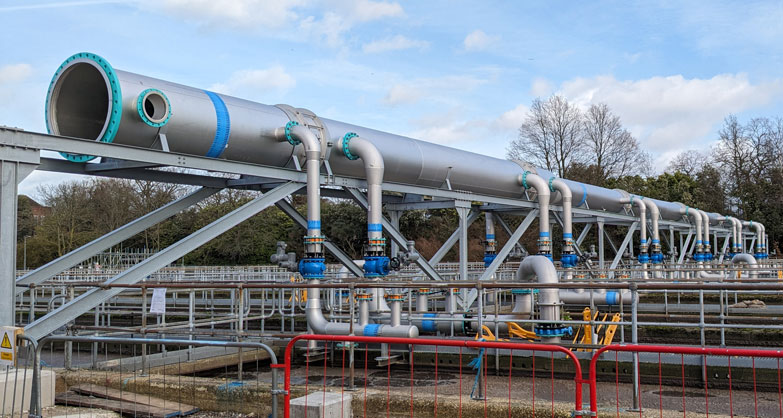
Barair Systems Limited supported a wastewater-sector project at Mogden by providing mechanical engineering verification and practical design support for retrofit support structures. In operational wastewater environments, reliability depends not only on strength calculations but also on buildability, maintainability and a realistic understanding of how equipment will be installed, accessed and operated. The aim of this work was to establish a credible design basis, verify critical mechanical aspects of the arrangement and produce a structured set of findings that could be used for sign-off and implementation planning.
Wastewater installations typically involve restricted access, short shutdown windows, aggressive environments and legacy interfaces where the available drawing information may be incomplete. These conditions increase the risk of problems emerging late in the project, either during installation or once the plant is back in service. At Mogden, the design therefore needed to be checked not only for mechanical adequacy but also for practical vulnerabilities that could affect reliability, maintainability or approval.
Barair’s scope included reviewing the geometry, load paths, supports and interfaces, verifying strength, stiffness and deflection where appropriate, examining joints and connections, and identifying issues such as stress concentrations, wear points or corrosion traps. Where the geometry or load path justified it, finite element analysis was used to support the assessment of local stress and deflection. In other cases, targeted hand calculations were applied so that the design basis could be confirmed efficiently without unnecessary complexity.
The work began with a review of drawings, dimensional information, site context and operating duty in order to define credible assumptions and relevant load cases. Boundary conditions and support interfaces were then considered so that the checks reflected real installation conditions rather than idealised constraints. Verification checks were completed on the critical features, while practical issues relating to access, maintainability and implementation risk were captured as a prioritised action list.
The outputs included an engineering review summary, FEA verification results as applicable, interface and maintainability notes, and an evidence pack structure suitable for project approval and handover. The resulting engineering position gave the project team greater confidence that the retrofit support arrangement was both mechanically credible and practically deliverable, reducing the likelihood of downtime, rework or delay during implementation.
