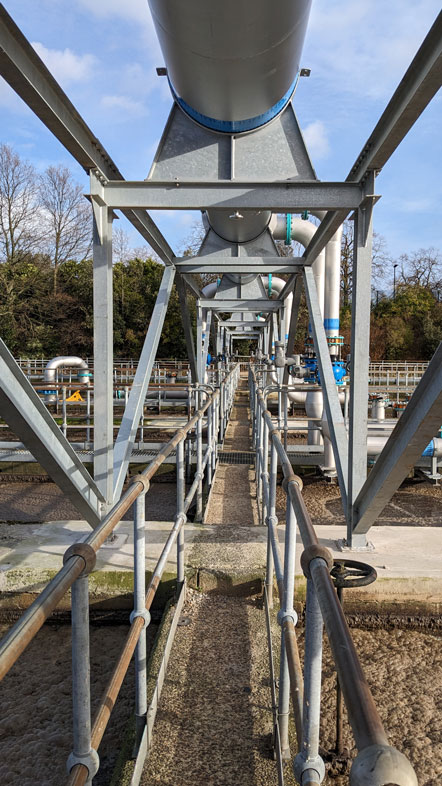
Barair Systems Limited supported a wastewater-sector project at Wanlip by providing mechanical engineering verification and design support for an air main support structure. The purpose of the work was to give the project team a clear engineering position on the design, identify vulnerabilities before installation, and recommend practical actions to improve robustness, maintainability and confidence in sign-off.
Projects in operational water and wastewater environments are often constrained by restricted access, limited shutdown windows, corrosive or contaminated service conditions and incomplete legacy information. Those factors increase the importance of early design verification, because weaknesses in supports, interfaces or access arrangements can quickly become operational issues if they are not identified before installation or modification work begins.
Barair reviewed the mechanical arrangement, interfaces and load paths for the Wanlip design and carried out verification checks for strength, stiffness and deflection where appropriate. Connections and joints were also reviewed, together with corrosion-prone details and practical maintainability risks. Where local effects or geometry warranted it, finite element analysis was used to support the assessment, while targeted hand checks were used to efficiently confirm the wider design basis.
The engineering approach began with a review of the available drawings, dimensional information, site context and intended operating duty. From there, boundary conditions and support assumptions were defined to ensure the FEA verification work reflected the actual installation rather than an idealised model. Critical members and interfaces were then assessed for utilisation, deflection and stability risk, while practical issues such as alignment, maintenance access, wear points and corrosion traps were captured as part of the project risk picture.
The work concluded with a set of structured findings and recommended actions that could be used by the wider project team to support design decisions and implementation planning. By identifying structural and interface vulnerabilities early and documenting the engineering basis in a usable format, Barair helped the team proceed with greater confidence that the final installation would be buildable, maintainable and reliable in service.
