
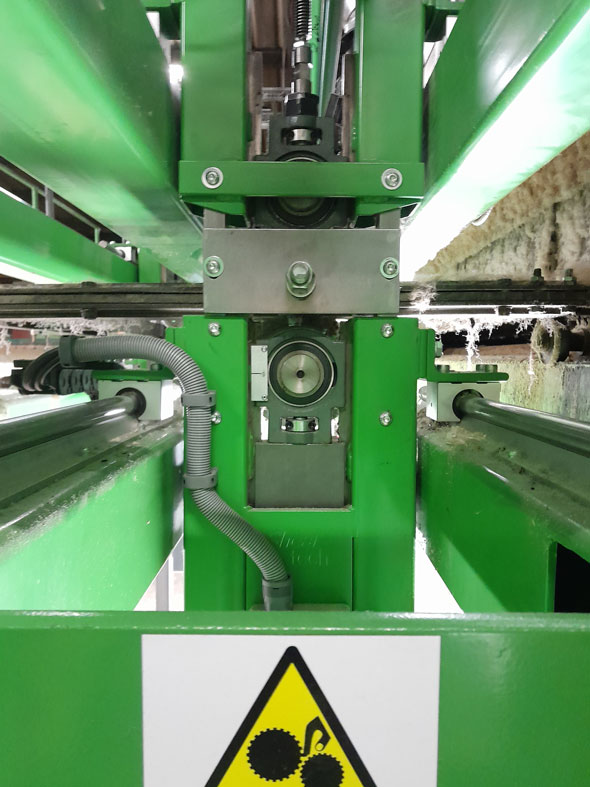
Penthouse Carpets commissioned Barair to investigate persistent alignment and lamination quality problems on a five-metre nip roller system used to compress carpet and backing fabric prior to latex curing. The objective was to restore reliable, repeatable operation and provide a practical improvement plan that could be implemented without unnecessary production disruption.
The issue was having a direct effect on both process stability and product quality. The nip roller arrangement was regularly drifting out of alignment, causing uneven lamination and, in some cases, a complete loss of lamination across part of the working width. The machine was intended to self-adjust and maintain even pressure across the full width, so the repeated misalignment indicated both a control problem and a potential weakness in the way feedback and correction were being handled.
Barair’s work began with an on-site assessment of the machine arrangement and likely failure modes, including the way the load-cell system was being used. One important finding was that the existing architecture provided only an averaged output signal, which limited the ability to understand or correct imbalance from one side of the machine to the other. From that point, the focus shifted toward creating a staged improvement concept that would give the control system more meaningful information and improve the machine’s ability to detect and respond to misalignment.
The proposed improvement path included obtaining independent end readings rather than relying on a single averaged signal, introducing additional distance sensing to detect crabbing or misalignment, and modifying the control-panel concept to accommodate additional inverter drives and the necessary input and output capacity. The work also considered practical operational improvements such as clearer fault indication and a staged installation plan that would minimise disruption by working around production days.
The deliverables comprised an evidence-led findings summary, a structured improvement plan, a practical control-panel modification concept to support contractor implementation, and ongoing coordination input with specialist suppliers and the automation partner. The outcome was a clearer engineering path to restoring stability in the lamination process, reducing repeat failures and giving Penthouse Carpets a workable basis for implementation and commissioning.
